
Food Cupboard Solutions – Simplify Your Storage
One of the most frustrating areas in a kitchen is the food storage cupboard. Tins mixed with onions mixed with stock cubes plus some loose grains of rice - no wonder it’s impossible to find all your ingredients or even decide what to cook each day, so let’s change that and make it easier to create more delicious meals.
Here are some simple tips to sort out your food cupboard, to make it easy to use. It will speed up your cooking, your food shopping and your finances, as you won’t need to over buy items any more - it’s a win-win-win!
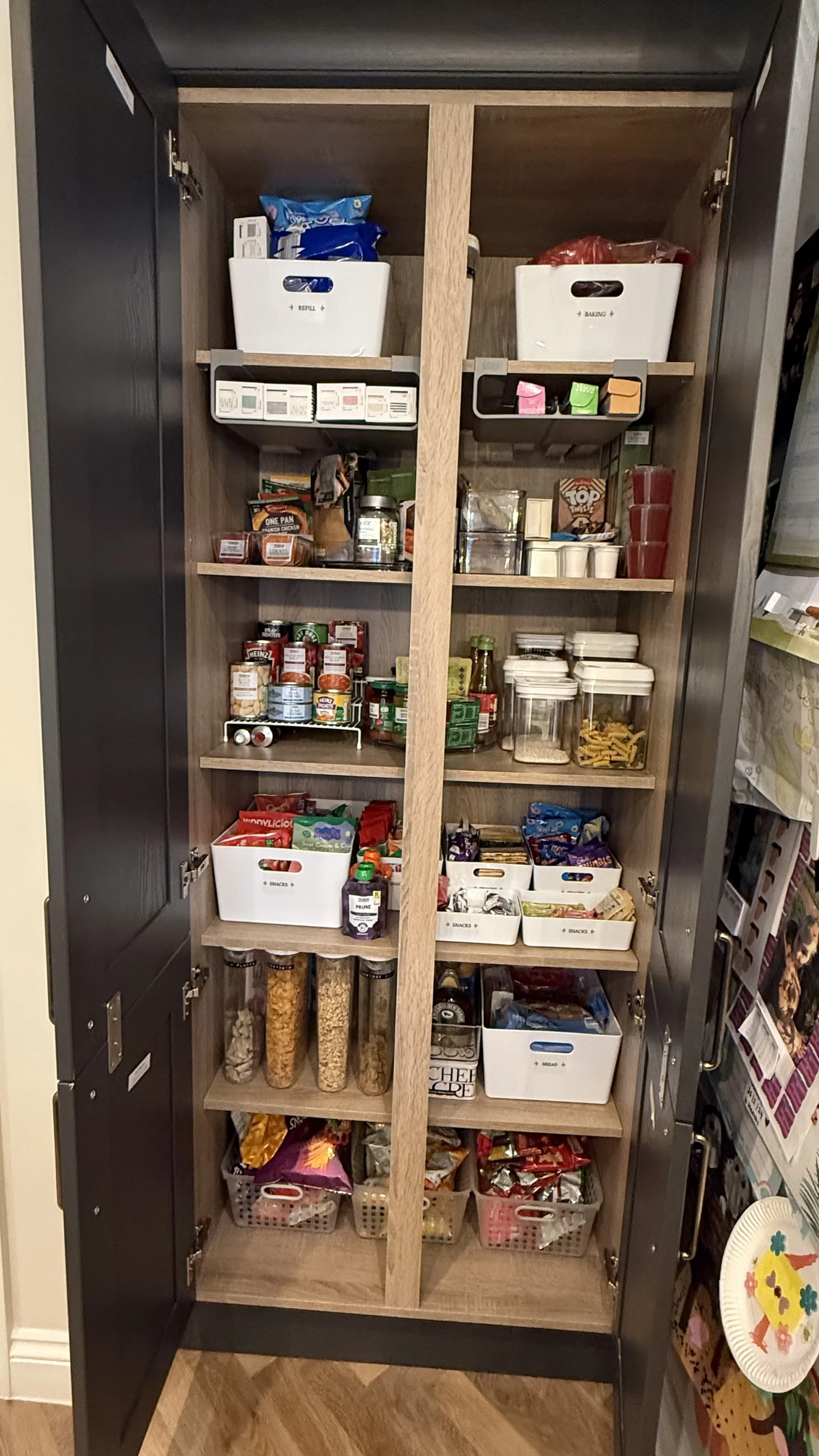
1. Firstly, empty out everything you’ve already got; categorise it (for example, all the pastas together, all the tins together) and check any expiration dates. Remove anything that is expired, it takes up precious space and is unlikely to be used again.
2. Clean the cupboards thoroughly - you don’t want to be putting food back on sticky or dirty shelves.
3. Discard as many boxes as possible - they take up so much space in a cupboard and are generally not needed. Make a note of sell by dates if it is food that goes off quickly, or will not be used in the next week (you can even just write it on the inner packaging in a sharpie!).
4. Think carefully about the storage you have, and the space you need to fill. Use stackable clear storage tubs (plastic or glass) for dry foods – you can see how much you have to prevent overbuying, and stack them to make use of taller cupboards. B&M Stores and the Range have some great, affordable options, or see this complete VTopmart set for an affordable set of different sizes. Boxes can also be really helpful to group different items together and make it easy to grab a selection of items - I use these for spreads and syrups, to make it easy to pop them on the table for pancakes. These Wham boxes are a fantastic option for food storage cupboards.
5. Use additional shelving inside cupboards to create extra storage space – these under-shelf storage drawers from Joseph Joseph are excellent for smaller items such as packets or stock cubes, whilst additional pop up shelves like these or these can create an extra layer to store items on. If you need to store tin foil, cling film or greaseproof paper, these larger under-shelf drawers from Joseph Joseph are ideal to free up some drawer space.
6. When you start to refill the cupboard, think carefully about where you put different types of food. Group like for like; all the tinned tomatoes together, all the tinned soups together; all the types of carbohydrates together. Have each item facing forwards; this creates an organised aesthetic and makes it much easier to see what is in your cupboard. If you are able to, group different categories of food on different shelves, so that your pantry is not too jumbled and it’s easy to grab whichever item you need in the midst of cooking.
7. If you have a hard to reach shelf up high, using a turntable like this is a game changer - no more straining to reach the items at the back. I use these in every single kitchen I work in, including my own - we have one in the fridge and two in the cupboards!
8. Finally - don’t just buy food for the sake of it - before you leave the house, take a minute to check your cupboards and see what you’ve already got. It takes seconds to take a quick photo of the cupboard before you head to the shops, and that second can save you money and prevent overbuying. Make use of recipes that you know and love to double up on ingredients, so if you’ve opened a packet of something you know you’ll use the rest soon.
Please note that all links included are affiliate links, meaning that as an Amazon Associate I earn from qualifying purchases. This does not cost you anything or increase the price for you in any way - the links are purely there as suggestions or inspiration for storage that I have used.